Showing posts with label 1992 Donruss. Show all posts

Random Rivalries: Brian Harper & Lonnie Smith

1992 Donruss #517 Lonnie Smith Front VS 1992 Stadium Club #296 Brian Harper Front

Why we like them: When you think about the most violent home plate collisions ever, this is the one should immediately come to mind. You could feel it through the television. In Game 4 of the 1991 World Series, Terry Pendleton hit a drive over the head of Twins centerfielder Kirby Puckett, which gave Smith reason to think he could score from second after watching it drop. The relay was whipped to the plate, and the ball and Harper were waiting. Smith barreled into the catcher, and Harper somehow held on for the out. It rattled the teeth just to watch it. Minnesota held on to win the game 3-2. (The collision also made for one of the coolest baseball cards of the 1990s, as you see below)

1992 Stadium Club #282 Lonnie Smith Front

Harper enjoyed a 16-year career as a .295 hitter. Smith played for 17 years and batted .288. Smith and Harper were even teammates on the 1985 Cardinals before Smith was traded to the eventual champion Kansas City Royals that season. Who did the Royals beat in the Series? You guessed it. Harper's Cardinals.

Ladies and gentlemen, Lonnie Smith and Brian Harper, ballplayers.

Rated Random: Roger Salkeld

1992 Donruss #7 Roger Salkeld Front
Potentially awesome.

Why we like him: Roger Salkeld was a super-duper prospect for the Mariners. He was the 3rd overall pick of the 1989 draft and had a good frame and good stuff. Salkeld battled injuries in the minors, but cracked the major league roster for the M's in 1993, starting 2 games and finishing with no decisions and a nice 2.51 ERA. However, things spiraled out of control after that. in 1994, Salkeld started 13 games, going 2-5 and posting a putrid 7.17 ERA. He was traded to the Reds for Tim Belcher but missed all of the 1995 season. He returned in 1996, finishing 8-5 with a 5.20 ERA for Cincinnati, but he never pitched again. So much for potential.

Ladies and gentlemen, Roger Salkeld, ballplayer.

Kevin Maas

Falling down holding a splintery shard of a bat with a goofy look on his face. Yeah, that pretty much sums it up for Maas and his career.

Why we like him: Kevin Maas always seemed like one of those guys who just had a tough start to his career, but would one day show up somewhere and put together a few decent years and help a team find some success. He was the "heir apparent" to Don Mattingly's aching body in the Bronx. He was left handed and built like a Greek god, and fans and scouts just knew he would be peppering the right field bleachers in Yankee Stadium with season after season of ridiculous home run totals.

In his first 79 games in the majors, Maas cranked out an impressive 21 homers and 41 RBI, which by1990 standards, seemed like the second coming of Lou Gehrig, and he garnered enough votes to finish behind only Sandy Alomar Jr. in AL Rookie of the Year voting. The following season, which was Maas's only true full season in the bigs, the league figured him out, holding him to 23 homers and 63 almost harmless RBI in 143 games while posting a measly .220 batting average. Yuck. Definitely not what the world's most passionate baseball fans were wanting. The Yankees gave Maas two more years to figure things out, and it just never happened. He was released prior to the 1994 season and bounced between minor league assignments with the Padres and Reds before given another chance at the majors with the Twins after the 1994 season. He didn't exactly make the most of it, batting a sad .193 in 22 games in 1995. He was released on June 30. He signed with the Yankees July 1 and never appeared in the majors again. At least I have his rookie card. I'm holding onto it too. He's the next Donnie Baseball.

Ladies and gentlemen, Kevin Maas, baallplaayer.

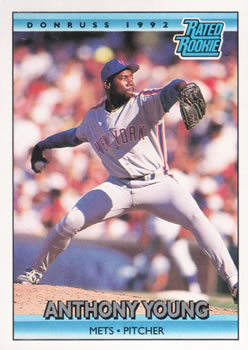
Rated Random: Anthony Young

Loser.

Why we like him: If you ever see a pitcher at any level that has lost a ton of ball games consecutively or otherwise, you know two things. First, he was probably a not a very good pitcher. Second, he was at least good enough to make his manager keep giving him the ball enough times to have the opportunity to lose all those ball games. Such is the legend of Anthony Young.

Anthony Young broke into the majors in 1991 with the Mets at the age of 25. Little did he know that it was actually the best Mets team he would pitch for. The Mets were suddenly becoming somewhat of a shambles of a ball club after their 1986 World Series title and a few subsequent years of success due in large part to the fact that most of the squad was too busy snorting massive amounts of cocaine to play the game very well. It's not like they weren't talented. They had Dwight Gooden, Bret Saberhagen, David Cone, and Sid Fernandez in the rotation and Howard Johnson, Dave Magadan, Eddie Murray, and Bobby Bonilla in the lineup, but they were simply terrible as a unit.

Anthony Young was one of the young guys with a clean conscience and clean drug test that arrived in Queens looking to solidify a spot in the rotation or a role in the bullpen. He wasn't a flashy, overpowering pitcher, but instead more of a "bulldog" kind of guy that just found ways to get batters out. He even saved 15 games for the Mets in '92. However, after losing to the Reds 5-3 on May 6, 1992, Young had no idea what he was about to experience. Young would go on to lose 27 consecutive games in which he had a decision over the next two seasons. He finished with a 2-14 record in 1992 and followed that up with a 1-16 mark in 1993. The streak came to an end on July 28, 1993 against the Marlins where Young won the game by pitching the top of the 9th inning, and the Mets scored two runs in the bottom half to win it.

Let's get this straight. Anthony Young was not a bad pitcher. The highest ERA he ever posted for a season was 4.59, and his ERAs in '92 and '93 were 4.17 and 3.77, respectively. He was just the undeserving recipient of a two-year run of excruciatingly bad luck, as evidenced by the fact that he never posted a winning record. His final numbers: 6 seasons, 3 teams, 3.89 ERA, and a record of 15-48. Poor guy. Now he's enjoying the baseball afterlife as a Little League coach in Texas. I would really like to see how he would have done on a better team with a little help. Maybe he could at least live in anonymity instead of being "the guy who lost 27 straight decisions."

Ladies and gentlemen, Anthony Young, Ballplayer.